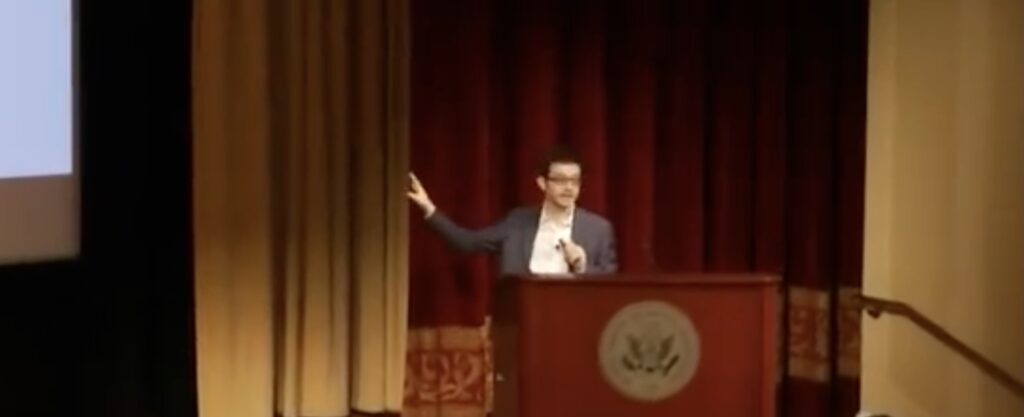
Workshop presentation, National Archives, Washington, DC
Speaking & Workshops
I offer interactive educational talks and small-group workshops for students focused on a specific challenge: explaining complex work to an intelligent audience outside the student’s field. Students often complete significant research, projects, or independent initiatives but have little practice explaining what drew them to the work or what they understood from it. These sessions explore how students translate their experiences — a skill that becomes especially important when students later write personal statements and application essays.
Who these workshops are for
- Summer research and academic enrichment programs
- Advanced high school STEM or humanities institutes
- Mentorship and internship programs for high-achieving students
- Educational nonprofits and museum-based learning programs
What the sessions are about
Many strong students can carry out complex academic work — research projects, technical competitions, advanced coursework — yet struggle to explain what they actually did or why it mattered.
When asked to describe their work, they often default to technical language, as if speaking to a teacher or mentor in their field. In doing so, the bigger picture disappears: their motivations, the decisions they made, and the questions that originally drew them in. In one case, a student working on AI models for wildfire prediction initially described the mechanics of training the models. Only after a long conversation did she describe the moment that led her there: watching the Malibu fires and wondering why technology could not better protect communities.
Students are rarely asked to communicate their work to an intelligent non-specialist audience. Many educational environments, particularly in technical fields, reward precision and correctness but leave little room for explaining personal motivation or interpretation. As a result, students learn to report information but not explain themselves. The sessions focus on helping them describe what their experiences meant and why they pursued them.
Why this matters
The difficulty isn’t simply a writing problem. It is a communication and thinking problem.
Students typically try to sound impressive, organized, or sophisticated. But most audiences are not measuring achievement; they are trying to understand how a person thinks — what they noticed, what choices they made, and how they interpret their experiences.
When students have a discussion with someone genuinely interested in their motivations, a shift frequently occurs. Someone who initially claims to have nothing interesting to say begins describing specific moments, decisions, and observations. They move from listing accomplishments to interpreting events. For the first time, they become the subject of their own thinking. This change is usually visible: students speak more freely, supply concrete detail, and become curious about their own reactions and motivations.
Learning to communicate in this way develops audience awareness, reflection, and clarity of thought — skills that apply far beyond any single assignment.
What happens in a workshop
Workshops are structured around guided conversation and analysis rather than lectures. Students discuss their projects, interests, or activities and are asked to explain them to someone outside their field. Questions draw out decisions, observations, and motivations that are usually left unstated.
Students often discover that they can explain themselves clearly in conversation even when they struggle to do so in writing. In dialogue they reveal details they would never think to include on a page — small observations, personal reasoning, or the moment a question first became interesting to them. These moments become starting points for deeper reflection.
Once ideas emerge verbally, writing becomes more productive for students. With a clearer understanding of what they are trying to communicate, students can work independently and explore their experiences more carefully.
Where these sessions are offered
These workshops are designed for educational settings that bring together motivated students, including summer academic programs, research initiatives, and enrichment organizations. They can be adapted for groups working in technical, business, or interdisciplinary areas, since the underlying challenge — explaining experiences to an informed reader or listener — is common across fields.
They have also been offered in public educational settings, including programs at the California Academy of Sciences.
Relationship to the college essay
The personal statement in college applications is one important application of the communication skills students practice in these workshops. Admissions readers are not specialists in a student’s field, yet they must understand how a student interprets their experiences. The same skills practiced in these sessions — reflection, audience awareness, and clear explanation — therefore become directly relevant to the college essay.
Some students apply these ideas independently. Others prefer individual guidance while developing their essays. Information about one-on-one coaching is available on the college essay coaching page.
Inquiries
To ask about scheduling a workshop or bringing a session to your program, please contact me here.
Interviews
Curious to hear me in conversation? In these podcast interviews, I discuss what makes an effective college essay — and how students can stand out in an increasingly competitive admissions landscape.
As Seen In